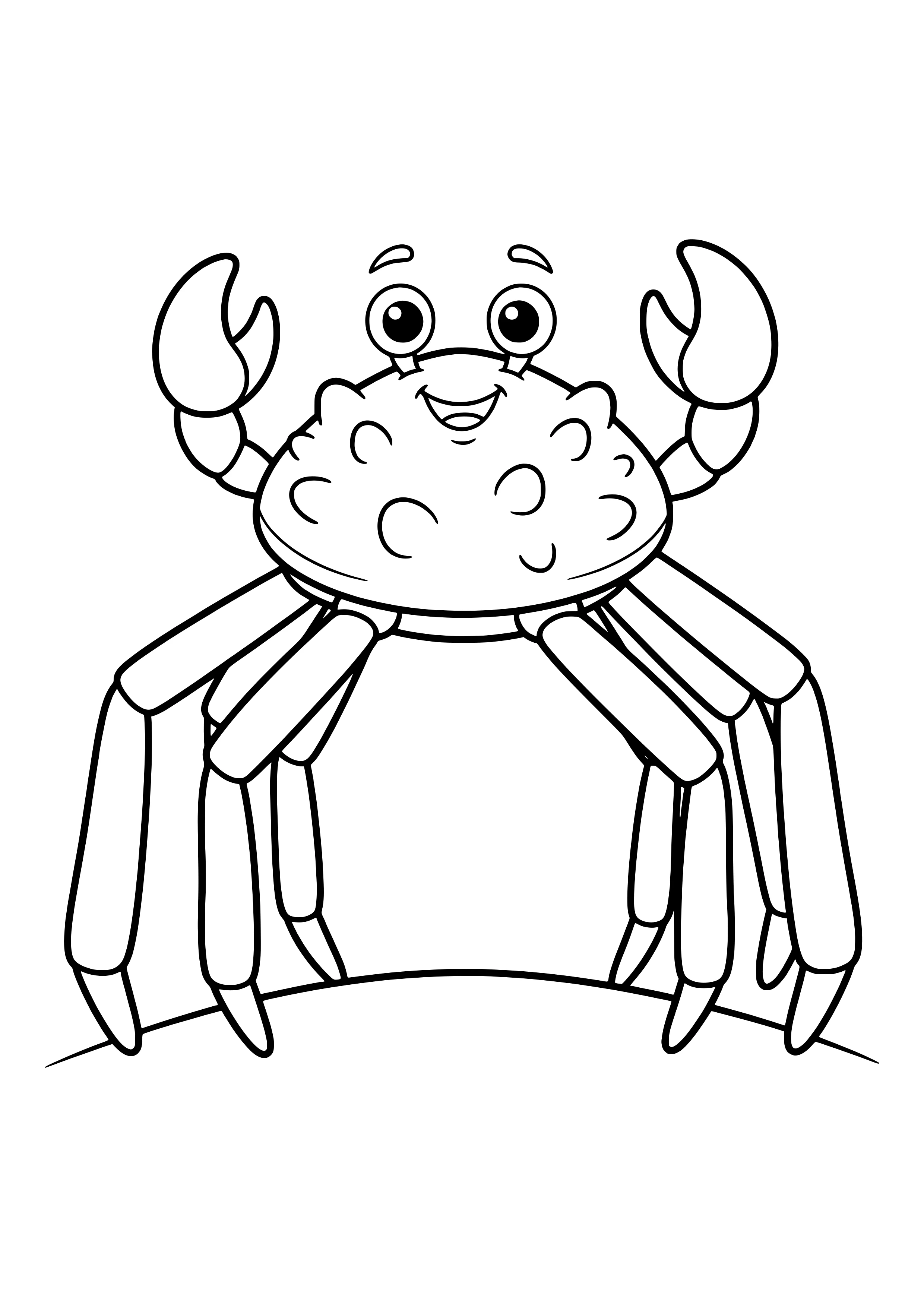
With its long, spiky legs, this mighty king crab walks majestically across the seafloor — one of the largest crab species in the world. Its impressive appearance and remarkable leg span make it one of the deep sea's most fascinating residents. Our king crab coloring page captures exactly this impressive moment, and you can print it for free right away.
Why This Coloring Page Shows Such Scale
The king crab's eight long, spider-like legs offer many exciting lines to color and can be shown in dynamic motion. The broad, armored body also leaves plenty of room for bold, rich colors that make this impressive crab feel especially majestic.
An impressive giant creature
Many lines in dynamic motion
Plenty of room for bold colors
An especially striking design
🖨️ Step-by-Step: How to Print Perfectly
Click "Print Now" and set your printer to black & white to save ink!
Use thicker paper (100–120gsm) for markers so colors don't bleed through
A quiet spot with good light — a washable tablecloth is gold for little artists!
Count all eight of the king crab's legs together!
🦀 Fun Facts About the Amazing King Crab
While your child colors, here's a great moment for a little story: king crabs are among the largest crabs in the world, reaching a leg span of over a meter when fully extended. Surprisingly, king crabs are biologically more closely related to hermit crabs than to true crabs, which you can tell from their asymmetrically shaped abdomen. These impressive animals often live in large groups on the seafloor and migrate together over long distances in search of food, walking remarkably steadily over uneven ground on their long legs. In especially cold waters, some king crab populations even gather into huge, tower-like groups where hundreds of animals climb on top of one another to protect each other from currents and cold. Anyone who wants to learn more about this fascinating giant creature can explore the king crab profile on Wikipedia together.
🎨 Creative Idea: What to Do with the Finished Picture?
Is the king crab all colored in? It deserves a place of honor on the wall! Afterward, talk about which other animals are actually related to completely different species than their names suggest. ✂️
🎨 Which Colors Suit the King Crab?
For this impressive design, bold, majestic colors work beautifully! Here are our favorite color ideas for little artists:
For the mighty shell
For the long legs
For the seafloor
For the water around it
💡 Coloring Technique Tip: Color each of the eight legs individually with fine outline strokes — it makes the king crab look especially detailed and lively.
📅 When Is This Coloring Page a Great Fit?
This design is a true all-rounder — here are our favorite occasions:
An impressive design for little ocean fans
Perfect for talking about animal classification
The many legs make for long, satisfying coloring time
An exciting design about a special creature
Perfect for stories about togetherness
🦀 Fun Facts About King Crabs for Kids
While your child colors, read these facts out loud — kids love nature trivia!
One of the biggest crabs in the world
Despite its name, not a true crab
They often migrate together
Walks confidently over uneven ground
Protection from cold in large groups
🦀 Discover the Whole Ocean World!
The king crab fits perfectly with our new collection of shellfish and mollusks! Combine several coloring pages and build a whole ocean world:
🌊 The Complete Shellfish Pack:
🦀 Why Do King Crabs Look So Much Like Spiders?
The thin, long legs of the king crab immediately remind many people of a giant spider, and that's not entirely wrong from a biological standpoint either: both spiders and king crabs belong to the large group of arthropods, whose bodies are made up of many movable segments. This relationship is quite distant, though, since king crabs live in water and breathe through gills, while spiders live on land and breathe through book lungs. Still, the similar body shape shows how different animal groups sometimes evolve remarkably similar solutions to the same challenges over time.
❄️ King Crabs in Icy Waters
King crabs feel especially at home in cold, nutrient-rich waters and are often found in regions with icy water temperatures, where they have adapted remarkably well to the cool conditions. Their thick shell and slow metabolism help them survive even in waters that would be far too cold for many other sea creatures. This adaptability makes the king crab a fascinating example of how life can thrive even under extreme conditions.
Your Benefits at PureSketchy:
- Thick Outlines: Clear lines for the shell and legs.
- Free to Print: Over 500 designs available instantly, no sign-up required.
- Safe & Fast: Instant access to PDF-optimized WebP previews.
- Suitable for All Ages: An impressive, majestic design.
Frequently Asked Questions (FAQ)
What age is this coloring page suitable for?
The king crab works for children of any age — from broad base colors to finely detailed legs.
Is the download free?
Yes, all coloring pages on PureSketchy are 100% free for personal use, preschools, and schools.
Which coloring tools work best?
We recommend bold red and orange tones for the shell.
Is the king crab really a true crab?
Surprisingly, not quite! Biologically it's more closely related to hermit crabs, even though it looks and is named like a crab.
Is there a German/English version?
Yes! You can find the German version at Ausmalbild Königskrabbe stapft über den Meeresgrund.
Do king crabs have any natural predators?
Yes, larger fish, sea otters, and even other crabs may prey on young or molting king crabs, though their size and spiny legs offer good protection once fully grown.
What do king crabs eat?
King crabs are opportunistic feeders that eat worms, small clams, sea stars, and even dead animals they find on the seafloor.