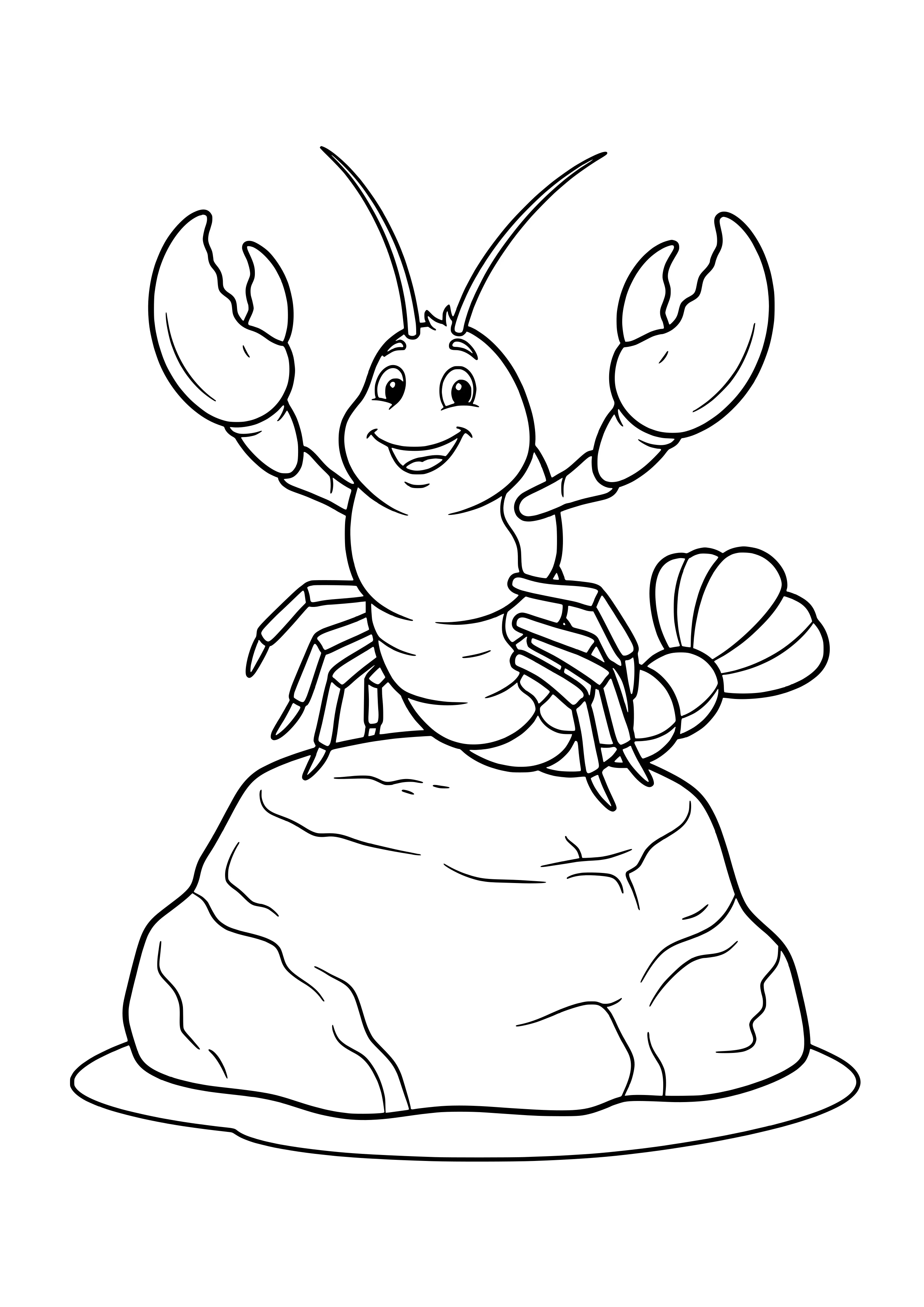
With its mighty claws, this lobster sits confidently on a rocky ledge — an impressive armored creature with a long life story. Our lobster coloring page captures exactly this proud moment, and you can print it for free right away.
Why This Coloring Page Has So Much Character
The mighty claws and segmented shell offer many exciting details to color, while the rocky ledge adds a lovely extra texture element. The impressive lobster feels especially confident and proud. With its long antennae, jointed legs, and strong tail fan, this design offers several anatomical details that kids can get to know just by looking closely and coloring carefully.
An impressive detail
An extra texture to design
Lots of detail to color
A proud armored creature
🖨️ Step-by-Step: How to Print Perfectly
Click "Print Now" and set your printer to black & white to save ink!
Use thicker paper (100–120gsm) for markers so colors don't bleed through
A quiet spot with good light — a washable tablecloth is gold for little artists!
Talk together about what the lobster might use its big claws for!
🦞 Fun Facts About the Amazing Lobster
While your child colors, here's a great moment for a little story: lobsters have blue blood because instead of iron, it contains a copper-based substance called hemocyanin that carries oxygen. If a lobster loses one of its mighty claws in a fight, it can regrow it completely over several molts — a fascinating regeneration process. Some lobsters also live remarkably long, reaching well over fifty years, molting again and again throughout their lives in order to grow. Interestingly, a lobster's two claws are often shaped differently: one usually serves as a powerful crusher claw for cracking hard shells, while the other has finer, sharper edges for cutting up prey. This division of labor makes the lobster a remarkably versatile hunter on the seafloor. Anyone who wants to learn more about this impressive armored creature can explore the lobster profile on Wikipedia together.
🎨 Creative Idea: What to Do with the Finished Picture?
Is the lobster all colored in? It deserves a place of honor on the wall! Afterward, talk about which other animals can regrow body parts, just like the lobster regrows its claws. ✂️
🎨 Which Colors Suit the Lobster?
For this impressive design, the shell can be colored boldly! Here are our favorite color ideas for little artists:
For the classic lobster shell
For the rocky ledge
For the water around it
For light reflections on the shell
💡 Coloring Technique Tip: Color the individual shell segments in slightly different shades of red — it nicely reveals the natural structure of the lobster's shell. The long antennae can also be traced especially precisely with a fine dark marker.
📅 When Is This Coloring Page a Great Fit?
This design is a true all-rounder — here are our favorite occasions:
An impressive design for little ocean fans
Perfect for talking about regrowing body parts
The many details make for focused coloring time
An exciting design about a special creature
A fun design for little foodie fans
🦞 Fun Facts About Lobsters for Kids
While your child colors, read these facts out loud — kids love nature trivia!
Copper-based oxygen carrier
A fascinating regeneration process
Some lobsters live over 50 years
How the lobster grows throughout its life
One for crushing, one for cutting
🦀 Discover the Whole Ocean World!
The impressive lobster fits perfectly with our new collection of shellfish and mollusks! Combine several coloring pages and build a whole ocean world:
🌊 The Complete Shellfish Pack:
🦞 Lobsters and Crabs — Close Relatives Compared
Lobsters belong, like crabs and shrimp, to the large group of decapods, named for their ten legs. Unlike most crabs, however, the lobster has an elongated abdomen with a powerful tail fan, which it can snap shut in an instant to catapult itself backward out of danger. This effective escape move sets the lobster clearly apart from its broader, sideways-walking crab relatives and makes it a remarkably agile sea creature despite its heavy armor.
🍽️ From the Seafloor to the Plate — A Look at Lobster Fishing
Lobsters have been considered a prized delicacy for centuries, which might surprise many kids thinking about the fascinating creature in their coloring page. To protect lobster populations, many regions today have strict rules, such as minimum sizes a caught lobster must meet before it can be kept. These protective measures help ensure enough lobsters get the chance to reproduce before being caught — an important example of sustainable use of the ocean's treasures.
Your Benefits at PureSketchy:
- Thick Outlines: Clear lines for the lobster.
- Free to Print: Over 500 designs available instantly, no sign-up required.
- Safe & Fast: Instant access to PDF-optimized WebP previews.
- Suitable for All Ages: An impressive design for any collection.
Frequently Asked Questions (FAQ)
What age is this coloring page suitable for?
The lobster works for children of any age — from broad base colors to finely detailed shell segments.
Is the download free?
Yes, all coloring pages on PureSketchy are 100% free for personal use, preschools, and schools.
Which coloring tools work best?
We recommend colored pencils in bold red tones for the shell.
Why isn't the lobster in this picture bright red?
Live lobsters are usually a mottled brownish-blue-green color and only turn bright red once cooked — so feel free to experiment with more natural shades when coloring, if you like.
Is there a German/English version?
Yes! You can find the German version at Ausmalbild Hummer auf einem Felsvorsprung.
Do lobsters really feel pain?
Scientists are still researching exactly how lobsters experience pain, since their nervous system is quite different from that of mammals, but many experts recommend treating them with care regardless.
Why does a lobster have two different-sized claws?
The larger crusher claw and the smaller cutter claw develop through use — a lobster that favors one side ends up with a bigger claw on that side over time.