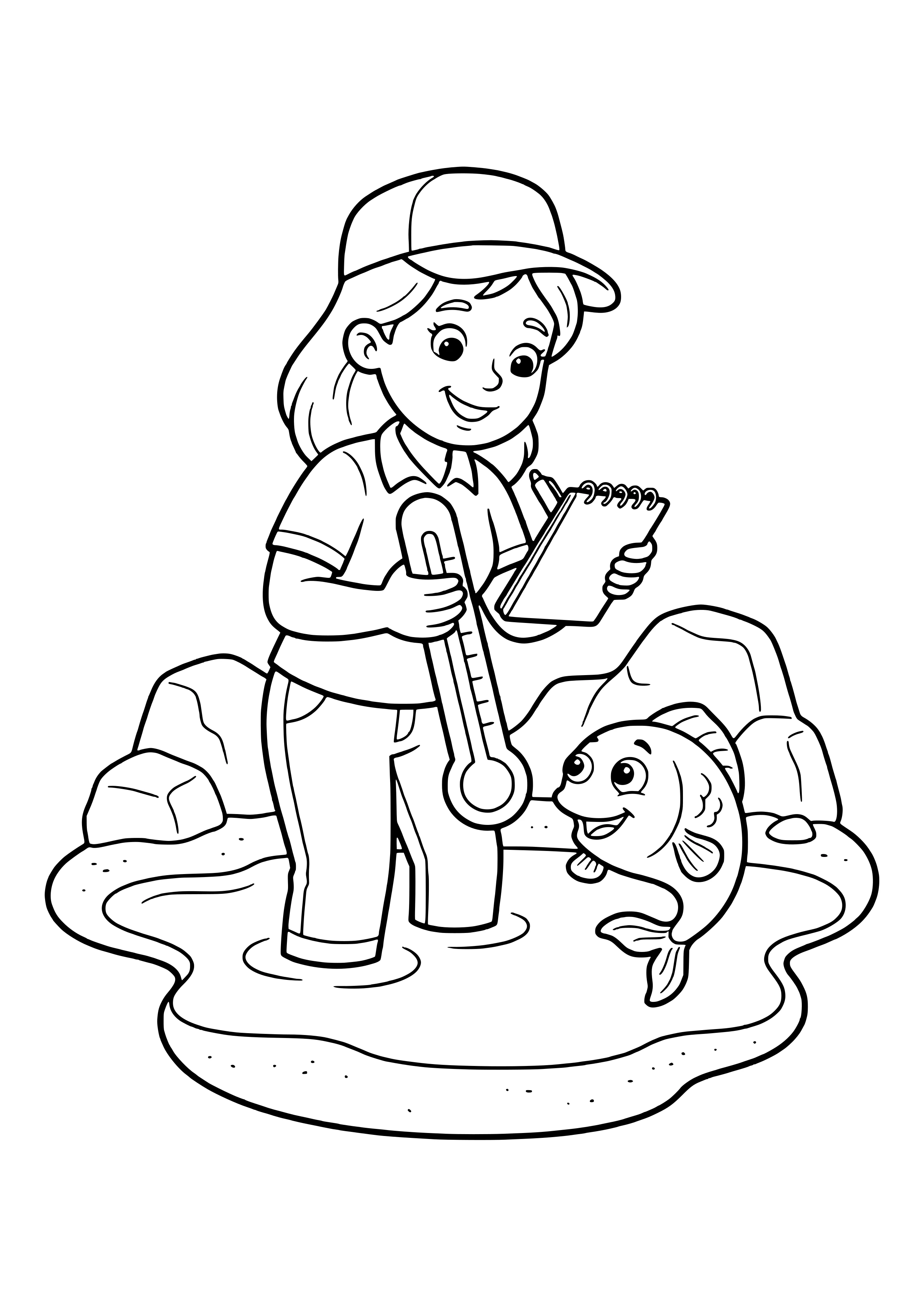
With a cap on, this cheerful young marine researcher stands knee-deep in the water, holding a big thermometer into it, a notebook in her other hand, while a smiling fish watches curiously nearby. Our marine researcher coloring page captures exactly this focused moment of research, and you can print it for free right away.
Why This Design Shows Real Science
With the thermometer in one hand and a notebook in the other, this design captures exactly what real research often looks like: patient, precise, and full of curiosity. The curious fish nearby adds plenty of room for a lively coloring experience.
Measures the water temperature
For recording measurements
Shielding from the sun
Watching the measurement
🖨️ Step-by-Step: How to Print Perfectly
Click "Print Now" and set your printer to black & white to save ink!
Use thicker paper (100–120gsm) for markers so colors don't bleed through
A quiet spot with good light — a washable tablecloth is gold for little artists!
Think together about why the sea warms up so much more slowly than the sandy beach!
🌊 Fun Facts About Why the Sea Warms and Cools So Slowly
While your child colors, now is the perfect moment for a little story: water has a very special property that scientists call "high heat capacity." That means water needs a huge amount of energy just to warm up even a little, far more than sand or air do. That's exactly why sand on the beach often feels scorching hot after only a short while on a hot summer day, while the sea right next to it stays pleasantly cool, even though both are exposed to the very same sun. For the same reason, the sea also cools down much more slowly than land in winter, which is why coastal regions often have milder winters and less scorching summers than places further inland. Real marine researchers measure water temperature in many different places over very long periods of time, because these measurements help us understand how Earth's climate is slowly changing over the years. Our little researcher with her thermometer is actually making an important scientific contribution with her measurement. Anyone wanting to learn more about the special properties of water can explore the Wikipedia article on heat capacity together.
🎨 Creative Tip: What to Do With the Finished Picture?
Finished coloring the picture? Tell someone why the sea warms up so much more slowly than sand, and feel the difference yourself between hot sand and cool water on your next beach trip! ✂️
🎨 Which Colors Suit the Marine Researcher?
For this scientific design, clear, friendly colors with practical accents work especially well. Here are our favorite color ideas for little artists:
For the water
For the cap
For the thermometer
For the fish
💡 Coloring Technique Tip: Deliberately leave the researcher's hair white and just trace the outline — that keeps the focus right on her focused expression.
📅 When Is This Coloring Page Perfect For?
This design is a real all-rounder — here are our favorite occasions:
A scientific design for the party
Perfect for a topic about heat capacity
For hands-on measuring tools
A scientific coloring project
🌊 Fun Facts About Water Temperature for Kids
While your child colors, you can read these facts aloud — kids love weather and climate knowledge!
Needs a lot of energy
Needs far less energy
Thanks to the sea's heat capacity
Us understand the climate
⚓ Discover More From the World of People & Vehicles Underwater!
The marine researcher is part of our new collection all about explorers and vehicles underwater! Combine all the coloring pages in this series and create your very own underwater adventures:
🌊 Discover more from Ocean World:
🏫 Ideas for Preschool, School, and Home
This design works wonderfully as a starting point for small projects about water, heat, and real research. In preschool, the picture pairs beautifully with a simple touch experiment comparing water and sand. In elementary school, this design makes a great introduction to a topic about heat capacity and coastal climate, while at home it serves as an occasion to observe temperature differences yourself on your next beach trip.
A touch experiment with water and sand
An intro to heat capacity
Observing temperature differences at the beach
🌡️ What the Marine Researcher Teaches Us About Careful Observation
The fact that a single patient measurement with a simple thermometer can help us better understand the bigger picture of the climate shows kids, in a particularly striking way, how valuable careful, precise observation can be. Just like our little researcher, it's worth carefully examining even seemingly small things, because sometimes they hold an important piece of a much bigger puzzle.
Your Benefits at PureSketchy:
- Thick Outlines: Clear lines, perfect for little hands.
- Free to Print: Over 500 designs available instantly, no sign-up required.
- Safe & Fast: Instant access to PDF-optimized WebP previews.
- Suitable for All Ages: A scientific, kid-friendly design.
Frequently Asked Questions (FAQ)
What age is this coloring page suitable for?
The marine researcher works for kids of all ages — the clear, practical shapes suit every age group well.
Is the download free?
Yes, all coloring pages on PureSketchy are 100% free for personal use, preschools, and schools.
Which coloring tools work best?
For the water, we recommend clear turquoise; for the cap, bold red.
Why does the sea warm up more slowly than sand?
Because water has a high heat capacity and needs far more energy to warm up than sand or air.
Is there a German/English version?
Yes! You can find the German version at Ausmalbild Forscher misst die Wassertemperatur.